

Pompeii, the wall that had not finished speaking

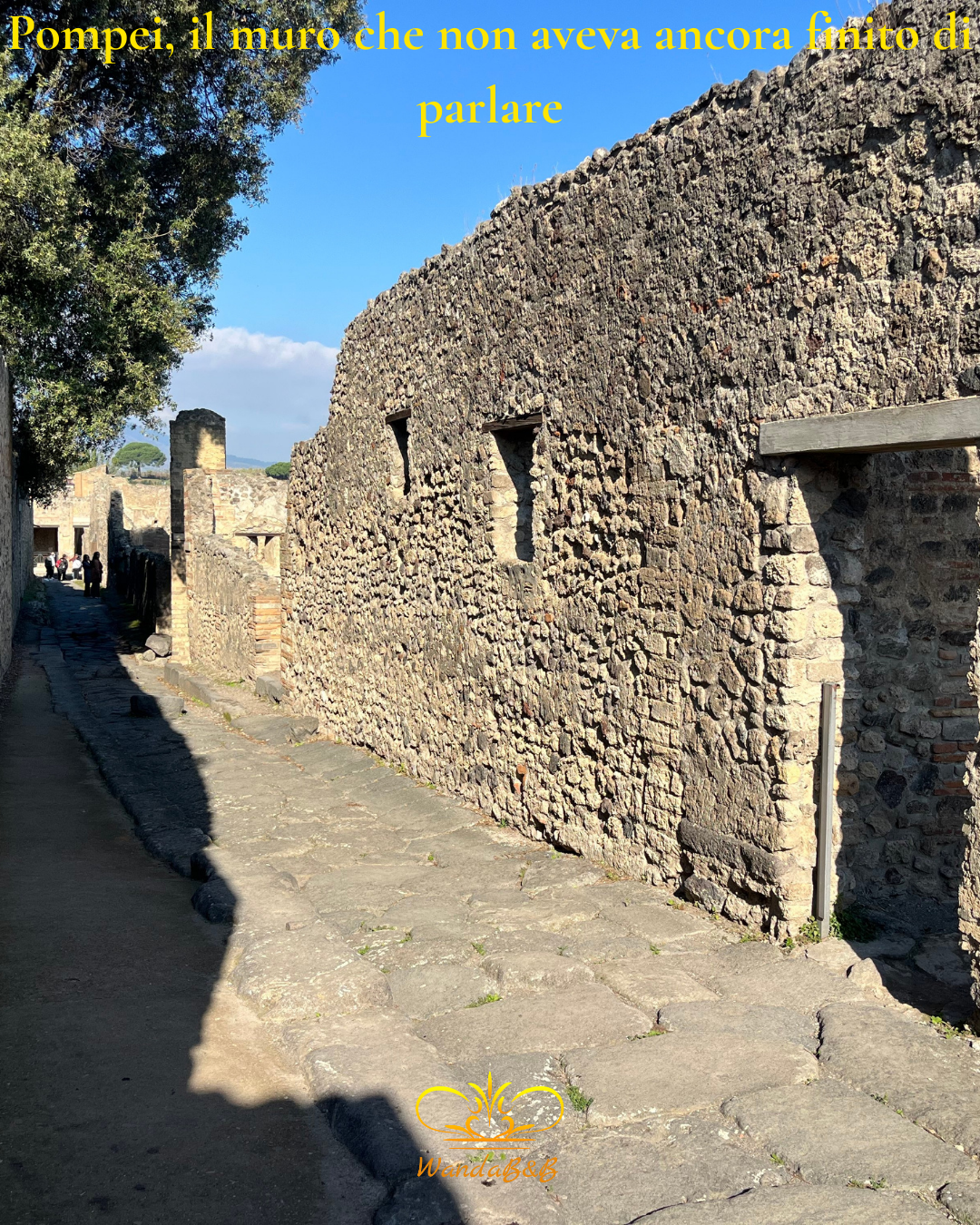
In Pompeii, there is a wall that seemed to have already said everything.
Excavated at the end of the 18th century, photographed, observed, crossed for over two centuries. A simple passageway. Yet right there, among worn plaster and almost invisible signs, new stories are resurfacing.
Not grand celebratory inscriptions, nor statues or spectacular treasures. But small bursts of everyday life: a name hastily written, a joke, a tease. And then love, which always appears in Pompeii when you least expect it.
"Erato loved...".
Few words, left on a wall as one would leave a chat message or a hastily written post today, without thinking too much about it.
That wall that seemed already read, today reveals new graffiti thanks to technology.
The "new" graffiti of Pompeii
The discovery stems from a project with an evocative name: Bruits de couloir, "Whispers in the corridor".
A joint effort between scholars from the Sorbonne, the University of Quebec in Montreal, and the Archaeological Park of Pompeii, developed in two study campaigns (2022 and 2025).
The goal was simple and ambitious at the same time: to revisit that corridor and truly reread it, as if it were still an open archive.
The result is surprising:
almost 300 inscriptions recorded
79 graffiti previously unknown, never documented before
Not because they were hidden, but because the human eye alone is no longer enough.
A lively, noisy, very human Pompeii
The graffiti tell everything.
Not only love, but also gladiators, insults, ironic jokes, incitements, brief dialogues. A lively, crowded, noisy Pompeii. At times tender, at times ruthless, like every public space crossed by real people.
That corridor was a hot spot for encounters:
quick greetings, heavy jokes, invocations to Venus, phrases left for those who would pass by later.
No one imagined that, centuries later, those signs would become a window into the daily life of antiquity.
And among all, a simple and powerful phrase endures:
"Erato loves."
Why this discovery is so important
The value does not only lie in the number of graffiti found, but in the message that Pompeii continues to convey:
even what seems already told can still surprise.
This environment was brought to light in 1794. Over 230 years ago. It took changing methods to discover that it still had much to say.
The scholars used:
virtual grids to map the inscriptions
spatial analysis to identify recurring themes
especially RTI technology - Reflectance Transformation Imaging
These are computational photographs taken with different angles of light, capable of bringing to light engravings now invisible to the naked eye.
The wall does not change. The way of looking at it changes.
Preserving Pompeii today also means digitizing
There is also a concrete urgency: these plasters are fragile.
Time, climate, and exposure consume them a little more each year.
For this reason, conservation is no longer just physical restoration, but also digital memory.
The Archaeological Park of Pompeii is clear: without technology, this heritage risks disappearing.
With over 10, 000 known inscriptions, Pompeii is an immense archive. Hence the idea of a 3D platform that integrates:
photogrammetry
RTI data
epigraphic metadata
Not just an archive for scholars, but a navigable and accessible space, capable of offering the public a deeper experience.
Pompeii today: a visit that never ceases to amaze
Visiting Pompeii does not just mean looking at ruins.
It means listening to voices that continue to speak, even from the walls we thought were silent.
And it is precisely this that makes Pompeii an unmissable stop for those staying in Naples:
a place that is never the same, because every new look can bring to light a forgotten story.
📍 From Wanda B&B, Pompeii is easily reachable in a day.
A short trip,