

The Bourbon Gallery: the Naples that lives beneath Naples

Wonderful is Piazza del Plebiscito and thrilling is the profile of Vesuvius. But Naples has many other cards to play - and some are found under your feet.
The capital of Campania indeed has a second skin pulsating beneath the asphalt, far from the traffic and the light of the gulf. The Bourbon Tunnel belongs precisely to this deep dimension: a place excavated with force, ingenuity, and - above all - political fear.
An underground system born to defend a king, later turned into a popular refuge, a repository of memories, and an extraordinary archive of half a millennium of history.
A work born for the king's safety
It was on February 19, 1853, when Ferdinand II of Bourbon authorized the construction of an underground viaduct to connect the Royal Palace with the barracks of Via Pace.
The task was entrusted to the architect Errico Alvino, a protagonist of important urban transformations in Naples.
🎯 The goal was not aesthetic but strategic:
to provide an escape route for the royal family
to allow for the rapid movement of troops
to strengthen security after the uprisings of 1848
The project was ambitious: a monumental tunnel about 12 meters high and wide, with two lanes side by side and gas lighting. Excavations began in April 1853 from the area of the current Via Domenico Morelli.
Technical problems and the unfinished work
During the works, complex difficulties emerged: the route intersected the active branches of the ancient Bolla aqueduct, still in use.
The Bourbon engineers responded with extraordinary solutions for the time:
lowering of hydraulic levels
construction of monumental internal bridges
counter walls to stabilize the cavities
The tunnel reached 431 meters, but the direct connection to the Royal Palace was never completed.
After the inauguration in 1855, the project stopped due to economic difficulties and political changes related to the Unification of Italy.
From an air raid shelter to a forgotten depot
The history of the tunnel does not end here.
Between 1939 and 1945, these spaces saved thousands of Neapolitans, turning into an air raid shelter during the bombings of the Second World War.
The following were installed:
stairs
electrical systems
latrines
whitewashed walls
After the war, the tunnel changed its appearance again, becoming a municipal judicial depot, where confiscated:
cars
motorcycles
statues
materials from collapses
Only in 2007, thanks to geologist Gianluca Minin, the recovery began, returning this extraordinary place to the city.
What to see today in the Bourbon Tunnel
The visit is guided and highly suggestive. In some sections, a helmet and torch are mandatory: you gradually descend into a parallel Naples that leaves you speechless.
🌉 The monumental bridges
In the heart of the tunnel, you cross spectacular suspended bridges above the ancient cisterns. Here, Bourbon engineering converses with the seventeenth-century one in a unique glance.
🚗 The vintage vehicle cemetery
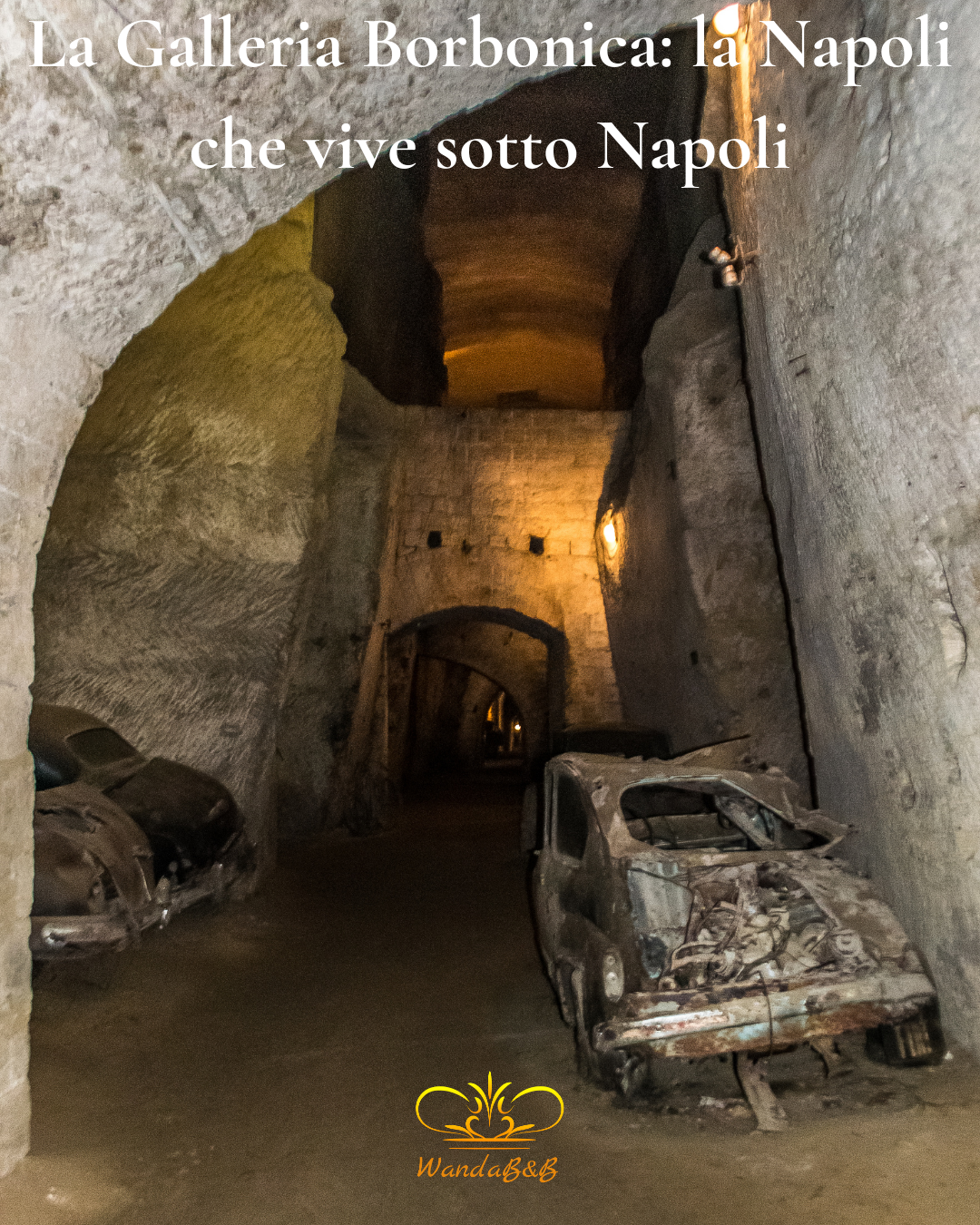
One of the most impressive scenes: rows of Fiat 1400s, Vespas, and vans from the '40s-'70s, covered in dust and calcareous concretions. They appear as sculptures suspended in time.
💧 The Bolla Aqueduct
An intricate system of tunnels and cisterns tells the hydraulic engineering of the seventeenth century. The crosses engraved by well diggers in the mortar are still visible.
🕯️ The shelters of the Second World War
Iron cots remain, forgotten toys, writings on the walls. Perhaps the most touching point of the entire journey.
🧭 Speleological and adventure routes
For the most curious, there are more adrenaline-filled itineraries, with narrow tunnels and even a section on a raft in a flooded gallery.
How to get to the Bourbon Tunnel
There are two main entrances:
📍 Via Domenico Morelli
most convenient entrance
ideal for the Standard route
📍 Vico del Grottone
a few steps from Piazza del Plebiscito
direct access to the seventeenth-century cisterns
🚇 Metro Line 1 stop