

Pompeii continues to tell the story of its last hours: two men fleeing from the eruption of 79 AD have been discovered.

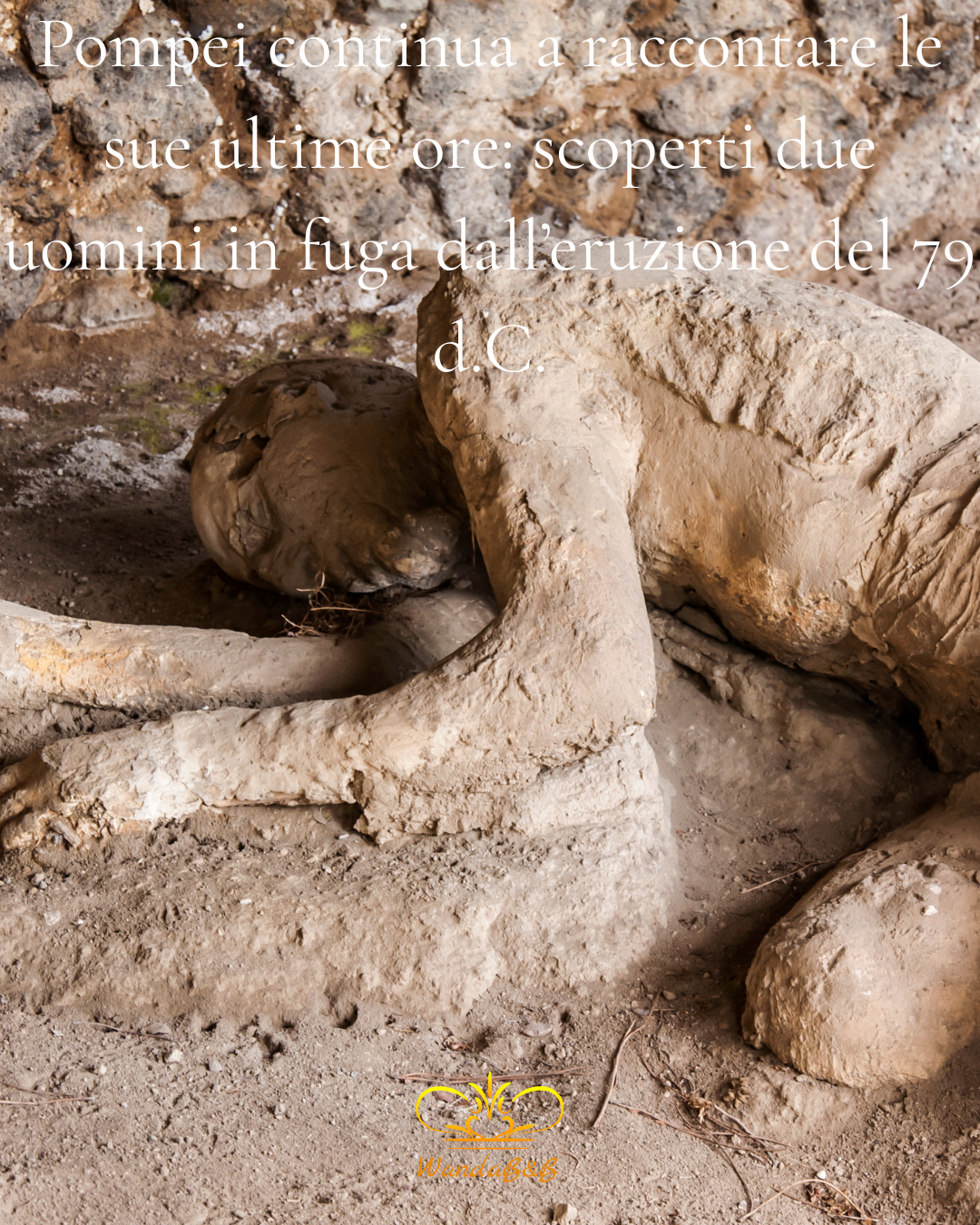
There are places that never stop speaking.
And Pompeii is one of them.
Each new excavation brings back fragments of daily life suspended in time for almost two thousand years. The latest extraordinary discovery comes from the necropolis of Porta Stabia, just outside the walls of the ancient city, where archaeologists have unearthed the remains of two men who died during the devastating eruption of Mount Vesuvius in 79 AD.
A discovery that tells not only the tragedy, but above all the desperate attempt to survive.
Two men, two escapes, the same fate.
The discovery took place during excavations in the area of the monumental tomb of Numerius Agrestinus Equitius Pulcher.
The two men would have died at different moments of that long day—or perhaps night—when the sky of Pompeii was darkened by ash, pumice, and toxic gases.
The first, probably older, was found next to a broken terracotta mortar that he was using to protect his head from the rain of volcanic stones.
A simple and human gesture that tells of all the fear of those moments.
In his hand, archaeologists also found a ceramic oil lamp: the city was now immersed in total darkness.
He also had with him ten bronze coins and a small iron ring.
The second man, younger, would have died a few hours later, overwhelmed by a violent pyroclastic surge: a scorching cloud of ash and gas that advanced without leaving any chance of escape.
Pompeii and artificial intelligence: the future of archaeology.
The discovery also represents an important technological breakthrough.
For the first time, the Archaeological Park of Pompeii has used artificial intelligence tools to digitally reconstruct the face and body of one of the victims.
The project was developed in collaboration with the Digital Cultural Heritage Laboratory of the University of Padua, combining archaeological data, photographs, and advanced digital models.
The goal is not to replace the work of archaeologists, but to help scholars and visitors better understand the human dimension of the tragedy.
Pompeii today is not only one of the most important archaeological sites in the world: it is also an international laboratory where history, technology, and research come together.
Why this discovery is so important.
Every find in Pompeii adds precious details about the daily life of the ancient Roman city.
But this discovery strikes a chord because it shows the humanity of the victims:
the fear, the attempts to protect themselves, the hope of surviving.
Not immobile statues from the past, but real people.
And perhaps that is why Pompeii continues to move millions of visitors from around the world: because here history does not seem distant.
It still seems alive.
Visiting Pompeii from Naples.
For those staying at the Wanda Bed and Breakfast, Pompeii represents one of the most fascinating excursions to experience during their stay.
From Naples, it is easy to reach the excavations by train or private transfer, experiencing a unique journey through archaeology, history, and panoramas dominated by Mount Vesuvius.
Because visiting Pompeii does not only mean seeing ancient ruins.
It means walking into a story that continues to emerge from the ashes today.