

The Cemetery of Fontanelle: where Naples speaks with its souls

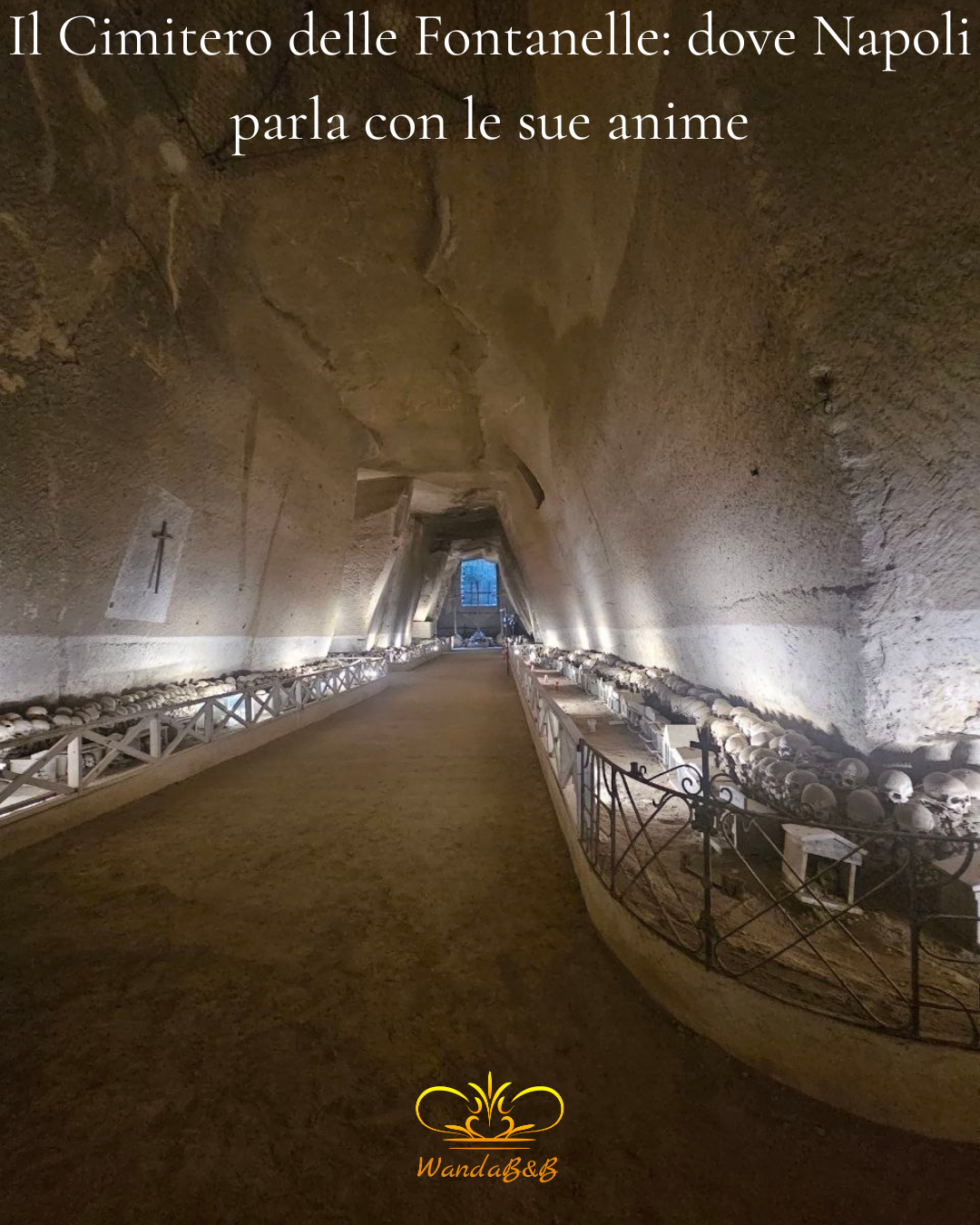
In the heart of the Rione Sanità, there is a place where death does not represent the end, but the beginning of a connection. It is the Fontanelle Cemetery, an ancient tuff quarry transformed over the centuries into an ossuary and become one of the most enigmatic and fascinating places in Naples.
Here lie thousands of anonymous bones and skulls. But above all, here was born one of the most singular traditions of Neapolitan culture: the cult of the "pezzentelle" souls, the forgotten souls of Purgatory that were adopted, cared for, and prayed for by the Neapolitans.
A place born in the heart of the city
The Fontanelle Cemetery is located in the Rione Sanità, one of the oldest and most historically rich neighborhoods in Naples.
The origin of the complex is linked to an ancient tuff quarry. Over the centuries, these large underground spaces were used to accommodate the remains of people who died during epidemics, famines, and other calamities, along with the bodies that could not be buried in normal cemeteries.
Today, the galleries house an impressive amount of human remains, arranged over time in an order that makes the place almost like a grand architecture of memory.
And it is precisely here that one of the deepest traditions of popular Naples is born.
The "pezzentelle" souls and the cult of the "capuzzelle"
To understand the Fontanelle Cemetery, one must know the meaning of the "pezzentelle" souls.
They were the souls of the forgotten deceased, without family or without someone to pray for them.
The Neapolitans could choose a "capuzzella, " that is, an anonymous skull, and take care of it.
The capuzzella was cleaned, arranged, and accompanied by prayers. In exchange, according to popular tradition, the soul could intercede for those who had adopted it, protecting and helping them in the difficulties of life.
It was a special relationship between the living and the dead: a gesture of care, faith, and hope.
The cult was banned in 1969 by Cardinal Corrado Ursi, but the memory of this tradition remains deeply rooted in Neapolitan culture.
The Tribunal: when the dead become witnesses
Among the most evocative places in the ossuary is the one known as "The Tribunal."
Here the skulls are arranged in such a way as to resemble a kind of silent assembly.
According to popular tradition, in front of these "capuzzelle, " thugs and members of the neighborhood's underworld would meet to make oaths and agreements.
Legend has it that a promise made in front of the dead had an even more sacred value: those who swore in front of the souls could no longer betray their word.
It is difficult to completely separate history from legend, but it is precisely this overlap between reality, faith, and popular imagination that makes the Fontanelle Cemetery so unique.
The Ossuary and the work of women
Another significant space is the Ossuary, where large bones are collected: femurs, tibias, vertebrae, and other remains.
The arrangement of the bones is not random.
For a long time, it was mainly women who took care of the capuzzelle and the ossuary spaces. They cleaned the skulls, arranged them, and accompanied them with prayers and small devotional objects.
An activity that may seem macabre to modern eyes, but for those women, it represented above all an act of piety and care.
In Naples, even death could become a form of relationship.
The symbols of the Passion
Inside the complex, there are also religious testimonies that recount the deep connection between popular worship and Christian faith.
In a small cavity carved in the tuff, there is still visible a fresco with a cross accompanied by some symbols of the Passion of Christ: the crown of thorns, the lance, and the stick with the sponge soaked in vinegar.
These are simple but strongly evocative images, inserted in an environment where popular devotion has left traces for generations.