

Pompeii, the mystery of the missing woman: jewelry and coins tell the story of life before the eruption of Mount Vesuvius.

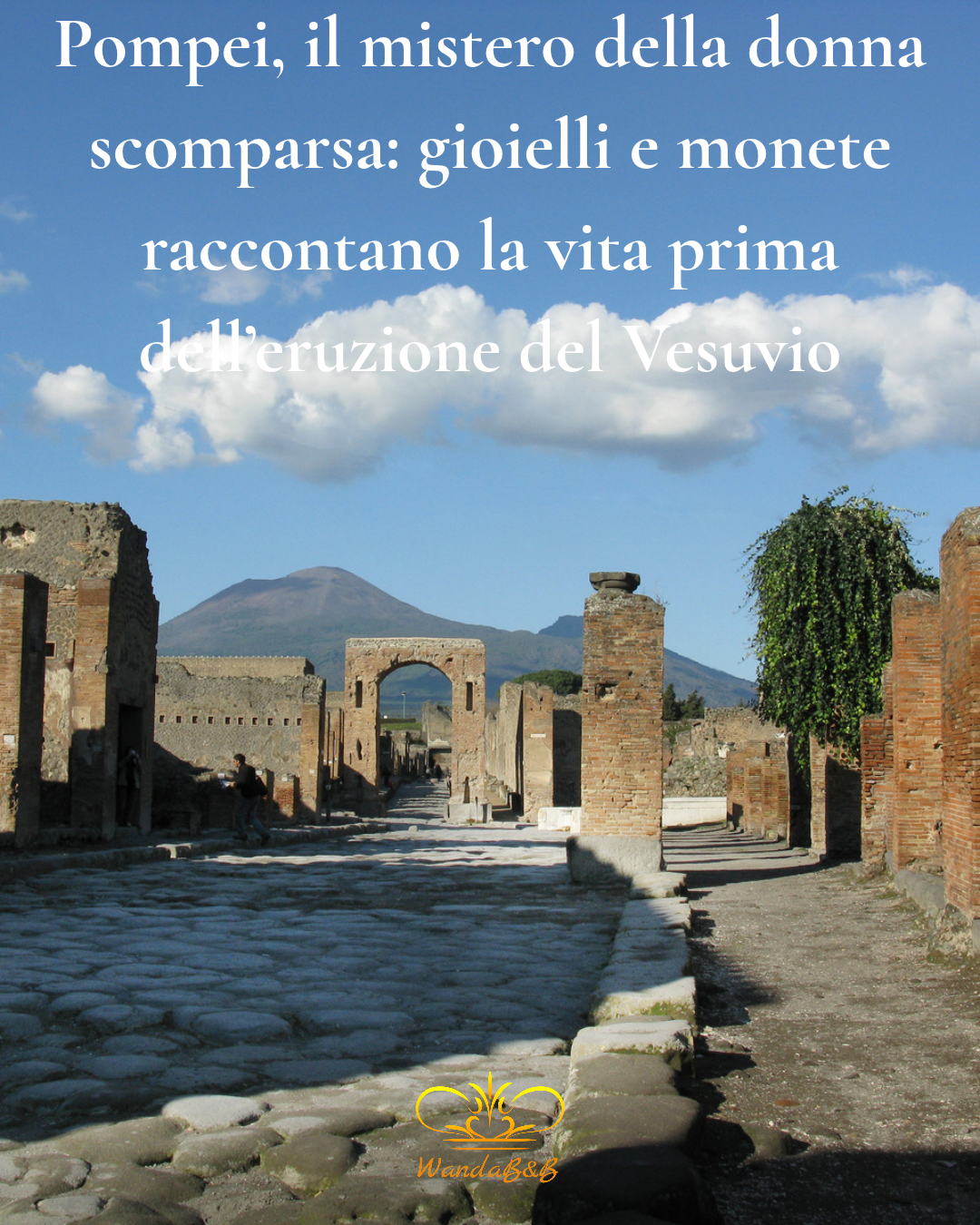
A cupboard full of jewelry, coins, and personal belongings. And a woman whose fate remains unknown. In Pompeii, an archaeological discovery has brought to light a fragment of everyday life, abruptly interrupted by the eruption of Mount Vesuvius in 79 AD.
At the House of Cornelius Maximus, during investigations connected with restoration work at the Insula of the Chaste Lovers, objects have been found that tell us about the customs, beliefs, and small gestures of Roman domestic life.
These are not just valuable artifacts: each object is a trace of the person who owned it and the life she led before the catastrophe.
🏺 **A cupboard that held an entire life**
Among the finds is a collection of jewelry, coins, and everyday objects that may have belonged to a woman who lived in Pompeii almost two thousand years ago.
Items associated with personal grooming, makeup tools, and an incense burner offer clues to some of the domestic habits of the time.
These details make the discovery especially fascinating: behind the walls of a Roman house, it is not just material wealth that emerges, but also an intimate world of everyday gestures, adornments, and personal rituals.
💎 **The necklace with 24 pendants: jewelry and protection**
One of the most significant objects is a necklace made up of 24 pendants depicting deities and protective symbols, belonging to a type known as *crepundia*.
These small pieces may have served as ornaments, symbols, or apotropaic objects—that is, objects believed to ward off danger and negative influences.
In the Roman world, jewelry and amulets could accompany people in their daily lives, expressing religious beliefs, hopes for protection, and personal attachments.
The necklace therefore offers a glimpse into the relationship between its wearer and the objects to which she entrusted, at least in part, a special meaning.
🪙 **The 38 coins and the sudden escape**
A small hoard of 38 bronze coins was also found among the artifacts.
The presence of coins and personal belongings left in the house is consistent with the possibility that the emergency prevented its occupants from retrieving everything they had kept there.
But what happened to the owner?
This is one of the most intriguing questions raised by the discovery. We do not know whether the woman managed to escape before the eruption made any movement impossible, or whether she fell victim to the catastrophe.
Her fate remains a mystery.
It is important to distinguish what the artifacts show from what we can only hypothesize: the objects reveal the presence of people and the habits of those who used them, but on their own they cannot establish with certainty what happened to the owner in her final moments.
🌋 **Pompeii: a city frozen in time**
The discovery is part of the archaeological and restoration work at the Insula of the Chaste Lovers, an area of the Pompeii site that continues to yield new insights into life in the ancient city.
The eruption of Mount Vesuvius in 79 AD destroyed Pompeii, but at the same time preserved buildings, objects, and evidence that today allow archaeologists to reconstruct aspects of Roman society.
What makes these finds extraordinary above all is their human dimension.
A piece of jewelry, a coin, or a makeup tool may seem commonplace. Yet, after almost two thousand years, they become precious testimonies to a real life, with its routines and concerns.
❤️ **Pompeii’s great lesson**
Pompeii tells not only the story of a natural disaster. It tells the stories of the people who lived in its houses, worked in its shops, and kept objects to which they attached economic, emotional, or symbolic value.
The chest in the House of Cornelius Maximus leaves us with a simple but powerful question: who was the woman who owned those jewels, and what happened to her when Vesuvius erupted?
For now, we don’t have a definitive answer. But it’s precisely this uncertainty that makes the discovery so compelling: through these objects, an unknown person briefly returns to the centre of our attention.
And it reminds us that behind every archaeological find lies not just a piece of history, but a human story we have yet to understand.
🏡 From Wanda B&B to the stories of Campania
If you’re staying in Naples, a visit to Pompeii is a wonderful opportunity to get up close to one of the most important archaeological sites in the world.
At Wanda B&B, at Via Luca Giordano 106 in the heart of Vomero, you can plan your stay and set off to discover the wonders of Naples and Campania.
Ciro will be happy to recommend places, itineraries and experiences that will help you discover not only the most famous monuments, but also the stories that make this region unique.
💚 Naples and Campania are a journey through the centuries. Come and discover them, starting from Wanda B&B.